The short answer
Above a desk, choose art about two-thirds the width of the desk and hang it so the bottom edge sits 20 to 30 cm above the desk, or 15 cm above the top of your monitor. For a 120 cm desk that means a 47 × 66 cm print; for a 140 to 160 cm desk, a 66 × 87 cm landscape print or a pair of 47 × 66 cm prints. If you take video calls, put one calm landscape print on the wall behind your chair, offset slightly to one side so your head doesn't hide it, and keep it out of the line of any window or ring light so the glass doesn't flare.
A home office is the one room where you look at the same wall for eight hours a day, and where everyone on your calls looks at the wall behind you. That makes art in a study work harder than art anywhere else in the house. It has to hold your attention without stealing it, survive a webcam, and fit around a desk, a monitor and usually a bookshelf.
Step 1: Decide which wall the art is for
How your desk sits in the room changes what the art is for.
Desk facing the wall
This is the most common setup in Australian spare rooms and studies. The art hangs above or beside your monitor, in your eyeline all day. Choose something calm and open, with a horizon or a lot of water or sky, rather than a busy, detailed scene you'll keep reading.
Desk facing into the room or towards a window
Now the wall behind you is the one people see on calls, and the wall in front of you may be a window. The art behind you becomes your video backdrop. This is the layout where a single, well-placed print does the most work, because it replaces the cluttered bookshelf or blank wall that most people show on screen.
Step 2: Size the art to your desk, not the wall
When art hangs over furniture, the furniture sets the size. The working rule used by interior designers is that the art should span about two-thirds to three-quarters of the width of the piece below it. Go much smaller and the print looks like it's floating; go wider than the desk and the wall looks top-heavy.
One detail that matters for Contemplo prints: our sizes are the image size, and every print has a 5 cm white border on each side. So a 47 × 66 cm print measures about 57 × 76 cm on paper before framing, and a 66 × 87 cm print about 76 × 97 cm. Use those border-inclusive numbers when you measure, and add a little more for the frame if you choose framed.
| Desk width | Single print | Width on the wall (with border) | Or a pair |
|---|---|---|---|
| 100 to 120 cm | 47 × 66 cm, landscape | about 76 cm (63 to 76% of the desk) | Not recommended, too crowded |
| 140 cm | 66 × 87 cm, landscape | about 97 cm (69%) | Two 30 × 42 cm portrait prints |
| 160 cm | 66 × 87 cm, landscape | about 97 cm (61%) | Two 47 × 66 cm portrait prints, about 122 cm across with an 8 cm gap (76%) |
| 180 to 200 cm (or a double desk) | 83 × 118 cm, landscape | about 128 cm (64 to 71%) | Two 47 × 66 cm portrait prints (61 to 68%) |
If your desk sits against a wall with no furniture-led reason to size the art, for example a print beside the desk rather than above it, size it to the wall instead. Our wall art size guide has the full method for open walls.
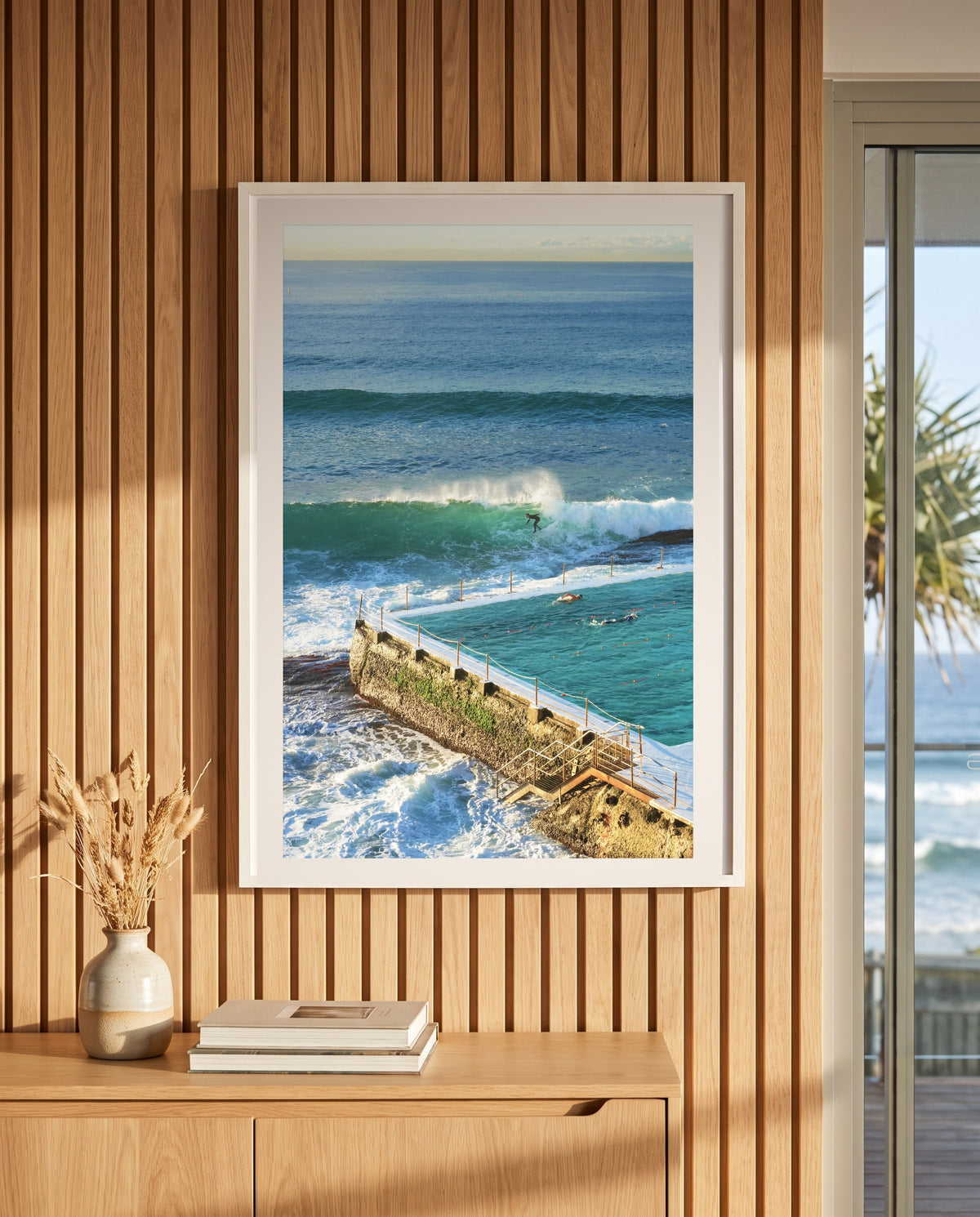
The same proportions work above a narrow desk or a credenza. Shown: Surfing at Bondi Beach, Icebergs.
Step 3: Get the height right around a monitor
The standard advice is to hang art with its centre at 145 to 152 cm from the floor. Above a desk that rule gives way to a simpler one: keep the bottom edge of the art 20 to 30 cm above the desk surface, so the art and the desk read as one composition. The catch in a home office is the monitor.
Worked example: a 140 cm desk with a monitor
- Most Australian desks are 72 to 75 cm high. Call it 74 cm.
- A typical 27-inch monitor on its stand reaches about 50 cm above the desk, so its top edge sits at roughly 124 cm from the floor.
- Leave 15 cm of clear wall above the monitor so the art doesn't look like it's sitting on the screen. The bottom of the print goes at about 139 cm.
- A 66 × 87 cm landscape print is about 76 cm tall with its border, plus a little for a frame. The top lands at roughly 217 to 220 cm.
- With a standard 240 cm ceiling, that leaves about 20 cm above the frame. It works, but it's the limit. A portrait print of the same size would hit the ceiling, so above a monitor, choose landscape.
If the numbers don't work, for example with two monitors or a monitor arm that lifts the screen higher, move the art rather than shrinking it. Hang it on the side wall, or on the wall behind you where it becomes your call backdrop. A small print squeezed into a gap above a screen almost always looks like an afterthought.
Step 4: Make it work on video calls
For many people the wall behind the desk chair is the most viewed wall in the house. Three things decide whether it looks considered or awkward.
Placement in the frame
On a laptop camera at seated eye level, your head sits in the middle of the frame, roughly 115 to 125 cm off the floor. A print hung at the standard 145 to 152 cm centre height will have its lower half hidden by your head. Two fixes:
- Offset it. Hang the print so its centre line sits 30 to 40 cm to one side of where your head appears. You stay centred, the print reads clearly over one shoulder, and the composition looks deliberate. Check it by opening your camera app before you put a single hook in the wall.
- Raise it slightly. If the print is centred behind you, lift it so its bottom edge sits just above head height on screen. Only do this when the art is behind you and not over furniture you can see, otherwise it will look like it's floating.
Choose a calm image
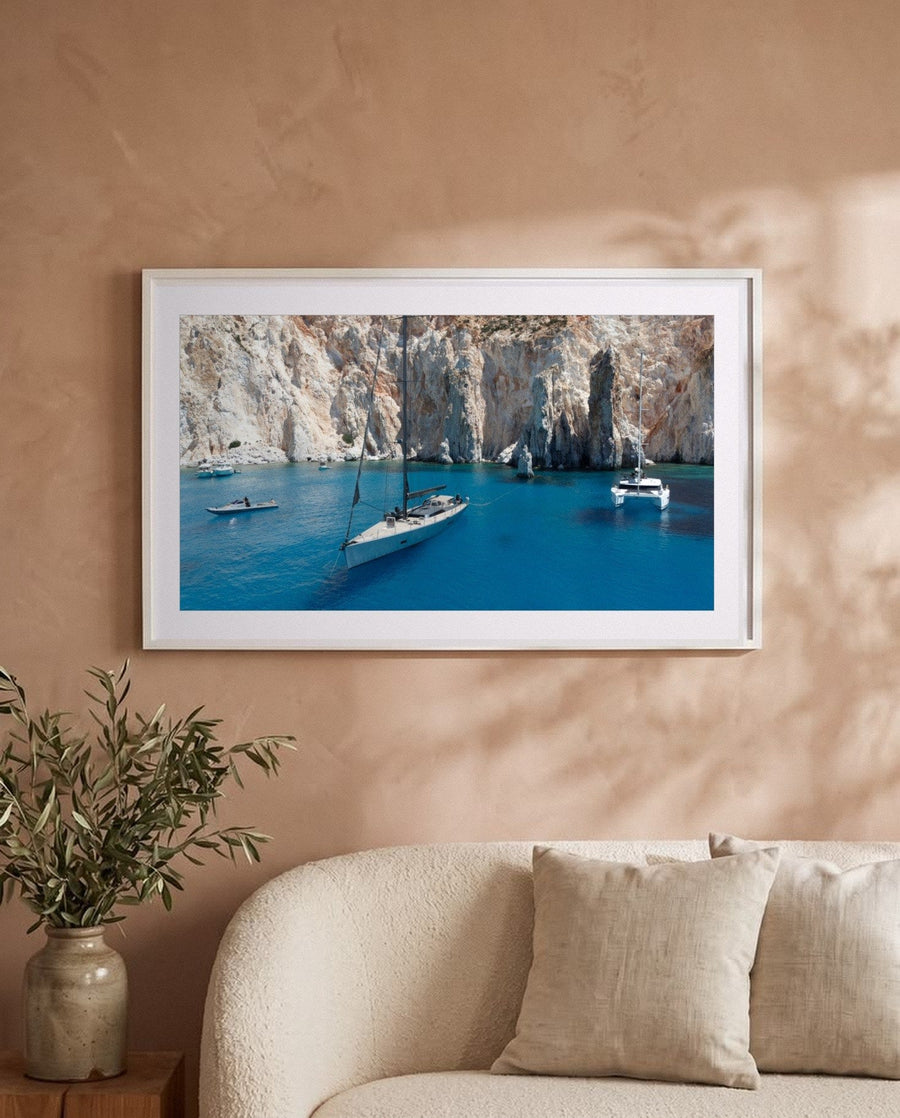
Video compression struggles with fine, busy detail: crowded beaches, dense foliage and fine patterns can shimmer or turn blocky on a call. Broad areas of colour come through cleanly. Open water, sky and simple coastlines are ideal. A landscape orientation also suits the 16:9 shape of a video frame better than portrait.

Broad areas of clear water and pale cliff read cleanly on a webcam. Ocean Blues, from our Greek Islands collection.
Watch the glass
The biggest call-backdrop problem is glare. Standard picture glass behind you will reflect a window, a ring light or a screen straight into the camera. Before you hang, hold a mirror or a phone screen flat against the wall where the print will go and look at it through your webcam: if you can see a bright light in it, the glass will show it too. Your options:
- Move the light, or angle the desk so the window is beside you rather than in front of the wall.
- Ask us about Non-Reflective or Museum UV Non-Reflective glass, which we quote on request. Museum glass has under 1% reflection.
Step 5: Pick an image you can look at for 2,000 hours a year
A full-time desk job is roughly 1,900 to 2,000 working hours a year. A print in a study gets looked at more than anything else you own, so choose something that holds up to repetition. A few general design principles help:
- Depth helps. Images with a horizon, a long view down a coastline or an aerial view give your eyes a far point to rest on after close screen work. A flat, near subject doesn't do the same.
- Cool colours sit back, warm colours come forward. Blues and greens generally read as calm and recede on the wall, which is why they suit a small study. Strong reds, oranges and high-contrast sunsets are wonderful in a living room but can feel loud at arm's length.
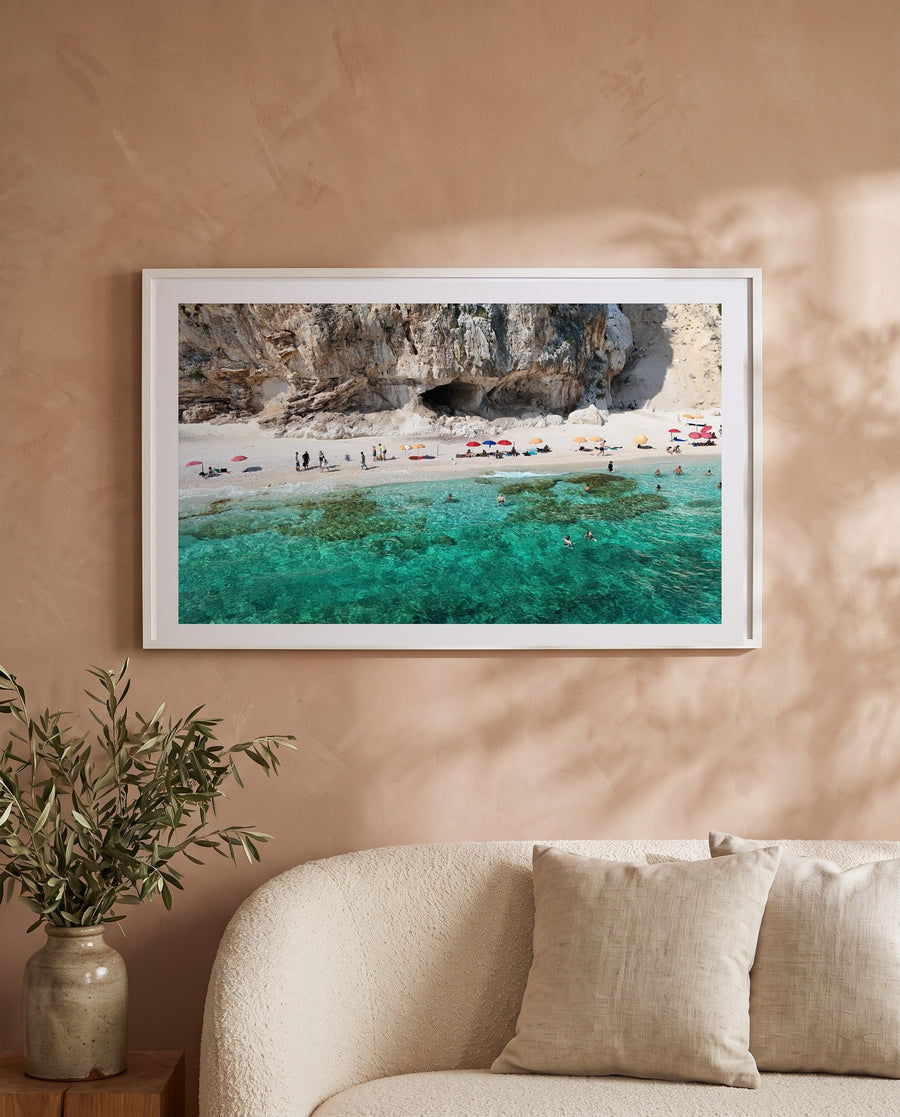
Practically, that points to the calmer end of our range. Lake Como is all still water and cypress green. Portofino and Granite Coast, Sardinia give you long, blue views with plenty of open space. Milos Rocks has a single strong shape against clear water and sky, which reads well from across a room and on camera.
Small studies, spare rooms and reading corners
Many home offices are a 3 × 3 m spare room that also fits a sofa bed or reading chair. In a small room:
- Don't default to small art. One 66 × 87 cm print makes a small room feel more deliberate than three 30 × 42 cm prints dotted around it.
- Give the reading chair its own piece. If you have an armchair or two in the corner, a print centred above the chairs and side table creates a second, quieter zone for reading or calls without the desk in shot.
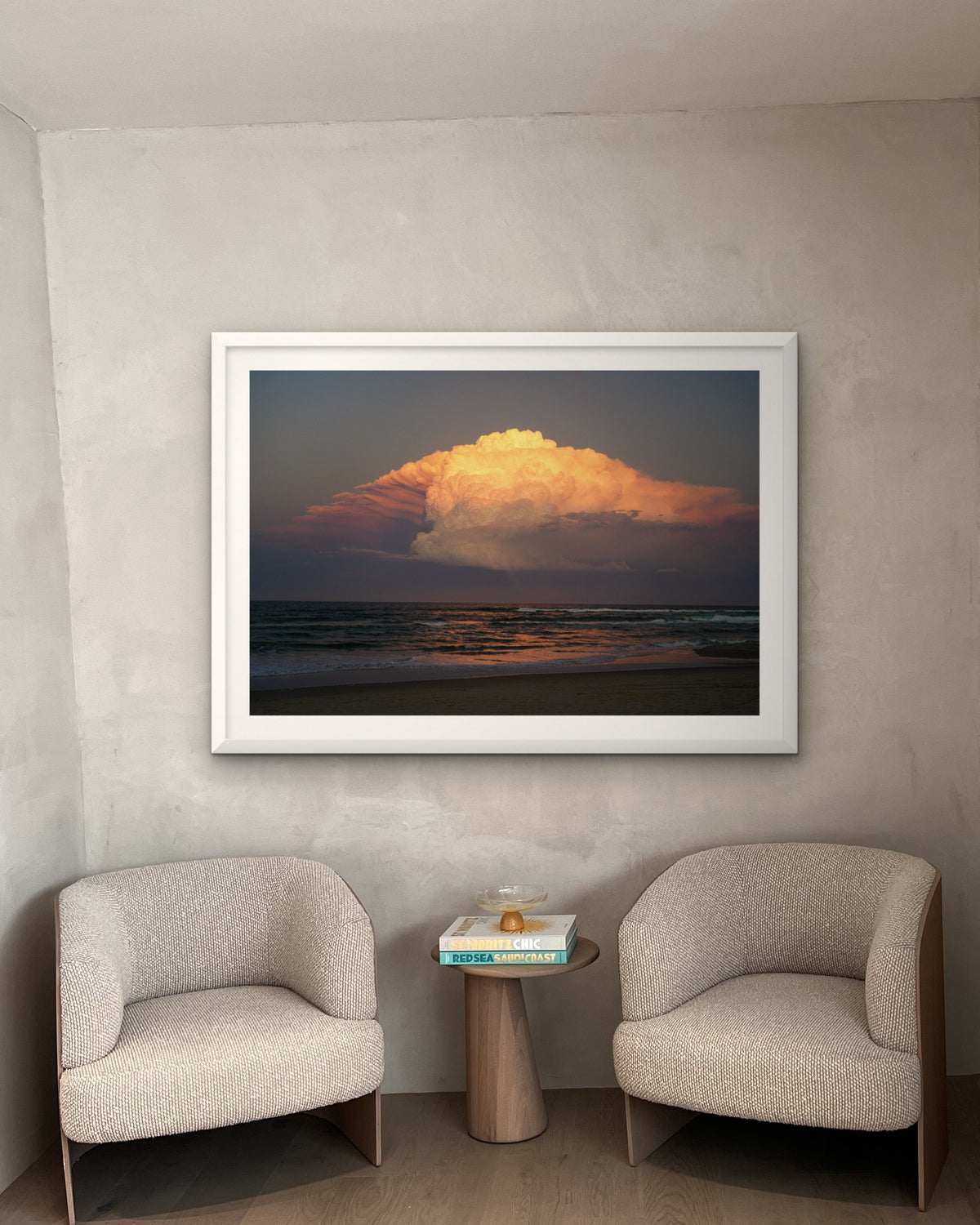
A reading corner set up as its own zone: two chairs, one side table and one landscape print centred above them. Shown: Where Skies Turn Gold.
Pairs above long desks and shared offices
If two people work side by side at a long desk, or you have a 180 cm desk or more, a pair often looks better than one very large print. Each person gets a print roughly centred over their half of the desk, and the pair still reads as one piece. Hang them 5 to 8 cm apart with their tops level, and centre the whole pair on the desk, not on the wall. Our guide to styling a pair of prints has spacing diagrams and more examples.
Our curated pairs are matched for colour and composition and cost about 10% less than two singles. A pair of 47 × 66 cm prints is $409 unframed or $969 framed.
What it costs
Current prices for single prints, in AUD including GST. Every print is made to order on archival fine art paper with a 5 cm white border.
| Size (image, cm) | Best for in a study | Unframed | Framed |
|---|---|---|---|
| 30 × 42 | Shelves, a narrow wall beside a window, one of a pair over a 140 cm desk | $169 | $389 |
| 47 × 66 | Above a 100 to 120 cm desk, beside a desk, one of a pair | $229 | $539 |
| 66 × 87 | Above a 140 to 160 cm desk, or behind your chair as a call backdrop | $279 | $699 |
| 83 × 118 | Above a 180 cm desk or a long credenza, or a large wall behind you | $329 | $999 |
| 100 × 150 | A feature wall in a large study or library | $499 | $1,459 |
Framed prints come in a white timber frame, ready to hang. Black, natural oak and other timbers are quoted on request, along with upgraded glass. If you'd rather frame locally, an unframed print ships free with tracking anywhere in Australia. The framed vs unframed guide covers the trade-offs.
If you're doing a whole room, our current offer is worth knowing: spend $700 or more on prints and add any 30 × 42 cm unframed print to your cart, and it's free. A framed 66 × 87 cm print for above the desk qualifies on its own, and the free small print suits a bookshelf. See the offer details.
Checklist
- Measure the desk width and multiply by 0.66 to 0.75 for your target art width, including the 5 cm border on each side.
- Measure desk height and monitor height, then add 15 cm to find the lowest point for the bottom of the art.
- Check the top of the art will clear the ceiling by at least 20 cm; if not, go landscape or move the art.
- Open your camera app at your normal seat and note where your head sits against the wall behind you.
- Offset a backdrop print 30 to 40 cm to one side of your head.
- Do the mirror test for glare from windows, ring lights and screens.
- Choose a calm image with depth and open space, in colours that echo something in the room.
- Mark the outline on the wall with painter's tape and live with it for a day before drilling.
Common mistakes
- Art that's too small over the desk. A 30 × 42 cm print alone above a 160 cm desk looks lost. Go up a size or use a pair.
- Art balanced on top of the monitor. Leave at least 15 cm of wall between screen and frame.
- Forgetting the window. A print opposite a bright window glares on camera and, in a sunny Australian room, gets more UV. Our print care guide covers sun and humidity.
Shop the edit


Frequently asked questions
What size art should go above a desk?
Aim for art about two-thirds to three-quarters of the desk's width. For a 120 cm desk, a 47 × 66 cm print (about 76 cm wide with its border, in landscape) is right. For 140 to 160 cm desks, a 66 × 87 cm landscape print or a pair of 47 × 66 cm portrait prints works well.
How high should art be hung above a desk?
Hang the bottom edge 20 to 30 cm above the desk surface. If you have a monitor, keep the bottom edge about 15 cm above the top of the screen instead, and check the top of the frame still clears the ceiling comfortably.
What's the best art to have behind me on video calls?
One calm, landscape-format print with broad areas of colour, such as open water or sky, offset 30 to 40 cm to one side of your head so it isn't hidden. Avoid busy detail, which shimmers on compressed video, and check for glare from windows and lights before you hang it.
How do I stop my framed print reflecting light on Zoom or Teams?
Move or angle the light source first, then test with a mirror held against the wall while your camera is on. If you can't avoid it, we quote Non-Reflective and Museum UV Non-Reflective glass on request. Email info@contemplo.shop with your size.
Want to see it above your desk first? Send us a photo of your study wall and we'll mock up any print at true scale, free. Request a free mock-up or try sizes yourself with the wall tool.
← Older post Newer post →