The short answer
Care for Art Prints: In a coastal or humid home, the four things that damage prints are direct sun, moisture, salt-laden air and careless cleaning. Hang framed prints out of direct sunlight, away from bathrooms, kitchens and cold external walls, and keep air moving around them. Clean glass and acrylic with a soft microfibre cloth (never ammonia on acrylic), and check each piece at the start and end of the wet season.
Living near the water is wonderful for the view and hard on paper. Queensland summers, sea breezes full of salt, afternoon storms and rooms that swing between air-conditioned cool and tropical heat all put stress on anything printed. The good news is that a few simple habits keep a fine art print looking right for many years.
This guide covers where to hang, what glazing to choose, how to deal with humidity and mould, how to clean glass and acrylic properly, and how to handle and store unframed prints. There is a checklist at the end you can save for your seasonal check.
What actually harms a print
Every Contemplo print is made to order on archival fine art paper, with archival satin as standard. Archival papers and inks are made to last, but no paper is immune to its environment. In coastal homes, the risks are:
- Ultraviolet light and direct sun. UV fades colour over time, and the blues and turquoises that make coastal photography sing are the colours you notice first when they shift. Direct sun also heats the frame, which speeds everything up.
- Humidity. Paper absorbs moisture from the air. High humidity can cause cockling (gentle waves in the paper), and sustained damp creates the conditions mould needs.
- Condensation. When warm, moist air meets a cold surface, water forms. Behind a frame on a cold external wall, or on glass in a room that is heavily air-conditioned, that can happen without you seeing it.
- Salt air. Fine salt spray settles on surfaces close to the beach. It attracts moisture, leaves a film on glass and can corrode metal hardware such as hanging wire, D-rings and screws over time.
- Handling and cleaning. Fingerprints on an unframed print, a wet cloth on a frame edge, or the wrong spray on acrylic glazing cause more avoidable damage than anything else.
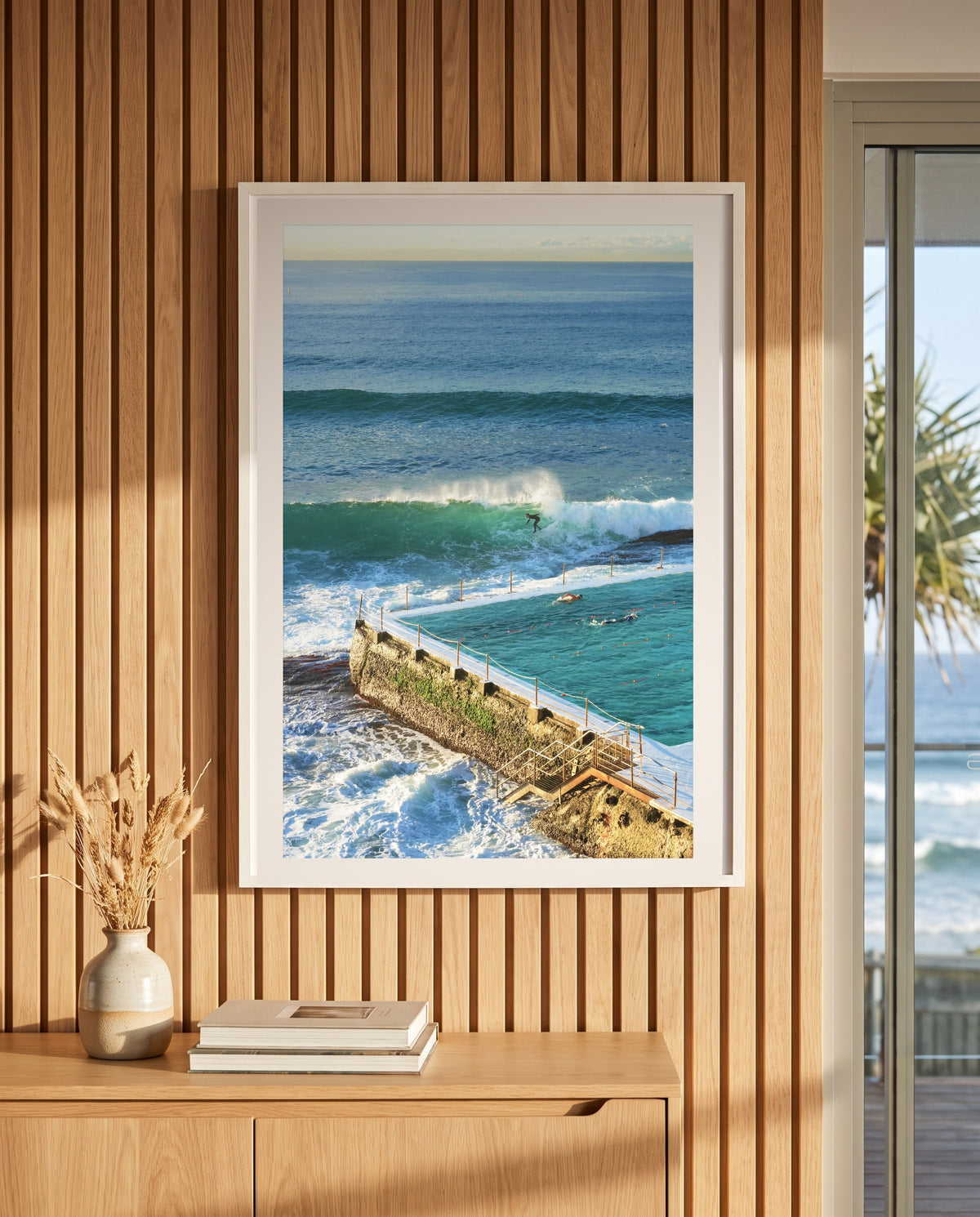
A bright coastal living room. The best wall for art is often the one that sees the view but not the sun.
Light: sun, UV and glazing choices
Light is the one risk you can control almost completely with placement. Before you hang anything, watch the wall for a full day. A wall that looks shaded at 9 am can take a strip of hard western sun at 4 pm, especially in summer.
Placement rules
- Avoid any wall that takes direct sun for part of the day, including the patch that moves across the floor and up the wall through a skylight.
- Walls at right angles to big windows are usually better than walls directly opposite them. You also get less glare.
- Sheer curtains, blinds and tinted or low-E window glass all reduce the light reaching your art. Use them in rooms with big glazing.
- Keep picture lights and spotlights at a sensible distance and use LED lamps, which run cool.
Glazing options
Every framed Contemplo print comes with glazing included, and upgrades are available on request for rooms that need more protection.
| Glazing | What it does | Good for |
|---|---|---|
| Standard glass | Clear, reliable protection from dust, touch and moisture. Included on framed prints up to 66 × 87 cm. | Rooms without direct sun or strong glare |
| Shatter-resistant acrylic | Lighter and safer than glass at large sizes. Included on 83 × 118 and 100 × 150 cm, with a deeper 45 mm frame. | Large statement pieces, family homes |
| Non-Reflective (on request) | Minimises glare | Bright rooms with lots of windows |
| UV Clear (on request) | Adds UV protection without distortion | Rooms with strong indirect daylight |
| Museum UV Non-Reflective (on request) | Blocks 70% of UV light and reflects less than 1% of visible light | The brightest rooms, and pieces you want to keep at their best long term |
Upgrades are quoted individually. See Framing, paper and glass for details, or ask us which option suits your room. No glazing makes a print sun-proof, so placement still matters most.
Humidity, mould and condensation
Humidity is the big one for Queensland and northern New South Wales, and for any home a short walk from the surf. You do not need museum-grade climate control, just a room that stays reasonably stable and dry.
Keep air moving
Mould grows where moist air sits still. A frame flat against a wall traps a small pocket of air behind it. Two simple fixes help:
- Fit small felt or rubber bumpers to the bottom corners at the back of the frame. They hold it a few millimetres off the wall so air can circulate.
- Run ceiling fans, open the house on dry days and use your air-conditioner's dry mode during long humid spells. A dehumidifier is worth it in rooms that always feel damp.
Watch external walls
Uninsulated external walls, especially masonry ones, can run cooler than the room. In winter, or in a room that is air-conditioned hard while it is hot and steamy outside, the back of a frame against that wall can attract condensation. If you have a choice, hang your most precious pieces on internal walls. If an external wall is the only option, use the bumpers above and check the back of the frame now and then.
Signs of trouble
- Fine spots or a fuzzy bloom on the print surface or the inside of the glazing
- A musty smell when you lift the frame off the wall
- Waves or ripples in the paper that were not there before
- Fogging on the inside of the glass
- Rust on the wire, D-rings or hooks
If you see mould, take the piece down, move it to a dry, airy room out of the sun, and talk to a professional framer or paper conservator. Do not open the frame and wipe the print yourself, as that usually spreads the spores and marks the paper.
Salt air and beachfront homes
If you can taste salt on the balcony, it is settling on your frames too. In absolute beachfront homes:
- Avoid hanging art on walls right beside doors and windows that are often open to the sea breeze.
- Wipe glazing and frames with a dry or barely damp microfibre cloth more often than you would inland, monthly if you can see a film forming.
- Check hanging hardware once or twice a year. Replace wire or hooks at the first sign of corrosion, and choose stainless steel hardware where you can.
- Never hang framed art on outdoor walls, including covered patios and alfresco areas. Printed works on paper are made for indoors.
Bathrooms, kitchens and laundries
Bathrooms are the trickiest room in the house for paper. Our honest advice is to avoid hanging fine art paper prints in a bathroom with a shower or bath. Steam rises, hits the cool glass and condenses, and humidity in a small, closed room spikes daily. Over time that is the perfect setting for cockling and mould.
If you really want art in a bathroom, choose a large, well-ventilated room with a strong exhaust fan, hang it as far from the shower as possible, and accept that it will need more checking. A powder room without a shower is a much safer option.
Kitchens bring heat, steam and airborne grease. Keep art away from the cooktop, kettle, dishwasher steam vent and the wall above the oven. A wall at the far end of an open-plan room is usually fine. Laundries combine humidity and lint, so they are best left without art.
Air-conditioning and heating
Air-conditioning is generally good for prints because it dries the air. The trouble is rapid swings. A few tips:
- Do not hang art directly in the blast from a split-system head or a ducted vent.
- Keep it away from heaters, fireplaces and heat-pump outlets.
- In holiday homes that are closed up for weeks, humidity can build inside. If you can, leave the air-con on a dry cycle timer, or leave internal doors open and blinds drawn to keep the place cool and dry.
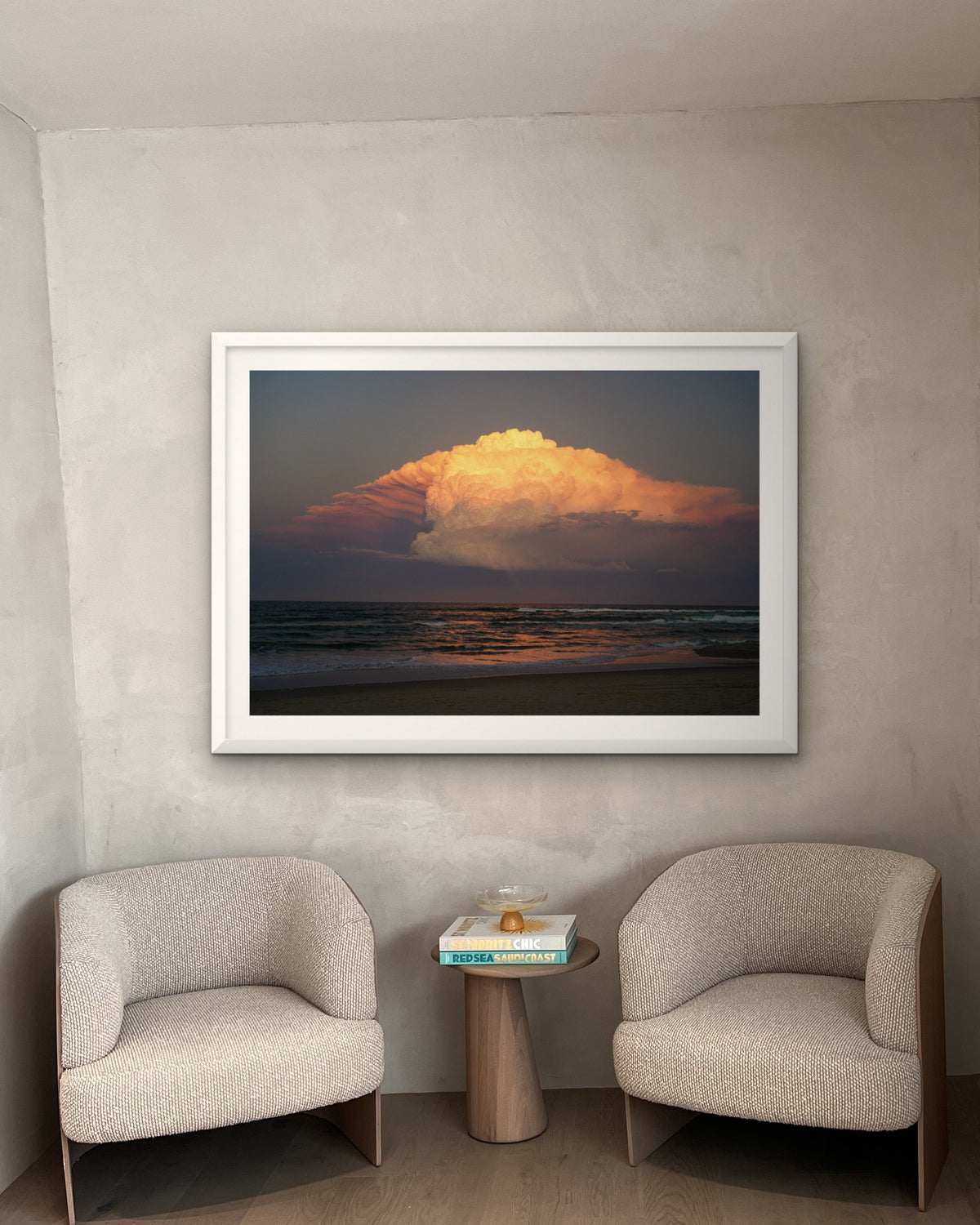
Where Skies Turn Gold, framed. Glazing protects the paper from dust, touch and moisture, so it pays to clean it the right way.
How to clean glass and acrylic
Most framed art only needs a light dust every few weeks and a proper clean a few times a year. The golden rule: spray the cloth, never the frame. Liquid sprayed onto glazing runs down and can wick under the edge of the frame onto the print.
Glass
- Dust the frame and glass with a dry, soft microfibre cloth or a soft brush.
- Lightly dampen a clean microfibre cloth with water or a small amount of glass cleaner.
- Wipe the glass, staying a little away from the frame edges.
- Buff dry with a second clean cloth.
Acrylic
Our 83 × 118 and 100 × 150 cm framed works use acrylic, which is lighter and shatter-resistant but scratches more easily than glass.
- Never use paper towel, tissues or rough cloths. Their fibres can leave fine scratches.
- Never use ammonia-based glass cleaners, solvents or anything alcohol-heavy. They can cloud or craze acrylic.
- Blow or brush off any grit first, so you do not drag it across the surface.
- Wipe gently with a soft microfibre cloth dampened with water, or a cleaner made for acrylic.
- Use straight, light strokes rather than scrubbing circles.
Acrylic can build up static that attracts dust, which is another reason a damp cloth works better than a dry one for the final wipe. For the white timber frame itself, a dry or barely damp cloth is enough.
Handling unframed prints
Unframed Contemplo prints ship free with tracking Australia-wide, and many people frame them locally. Until they are in a frame, they are at their most vulnerable.
- Clean, dry hands, or cotton gloves. Skin oils leave marks that can show up later, especially on satin and darker areas.
- Hold by the white border. Each print has a 5 cm white border. Use it, and support larger prints with two hands, or slide them onto a sheet of card to move them.
- Let it relax flat. If your print arrives rolled, unroll it on a clean, dry table with the image facing up, and weight the corners with something soft and clean. Do not reverse-roll it tightly or press it under heavy books.
- Frame it soon. In a humid climate, a bare print pinned or taped to a wall is exposed to everything this article warns about. Have it framed behind glazing as soon as practical.
- Ask for archival materials. If you frame locally, ask your framer for acid-free mounts and backing, and a frame that keeps the glazing from touching the print surface.
Storing prints
For prints you are not ready to hang, or framed pieces you are swapping out for a season:
- Store unframed prints flat in an acid-free folder or box, with acid-free tissue between them.
- Keep them inside the living areas of the house, not in a garage, shed, roof space or under-house storage, which are the hottest and dampest places in most Queensland homes.
- Store framed pieces upright, on their edge rather than flat, with card or a blanket between frames so glazing does not touch.
- Keep them off concrete floors and away from external walls.
- Avoid plastic bags or sealed tubs for long-term storage, because they can trap moisture.
Your seasonal check
A quick look twice a year catches almost every problem early. Good times in Queensland are the start of the wet season (around November) and the end of it (around April).
Checklist
- No direct sun lands on the piece at any time of day
- Not hung near a shower, cooktop, kettle, heater or air-con outlet
- Bumpers on the back corners so air can circulate
- Back of the frame and the wall behind it are dry, with no musty smell
- No spots, fogging or bloom on the print or the inside of the glazing
- Paper sits flat, with no new waves or ripples
- Wire, D-rings and hooks show no rust and are holding firmly
- Glazing cleaned with microfibre, cloth sprayed rather than the frame, no ammonia on acrylic
- Stored prints are flat, interleaved with acid-free tissue and kept inside the house
For more on placement, see our guides to how to hang wall art and framed or unframed prints, and our room-by-room guide to coastal wall art.
Shop the edit


Frequently asked questions
Can I hang an art print in a bathroom?
We recommend against it in any bathroom with a shower or bath. Daily steam and condensation can cause the paper to cockle and create conditions for mould. A powder room without a shower, or a large, very well-ventilated bathroom with art hung far from the shower, is a safer compromise.
How do I stop mould on framed prints in a humid climate?
Keep air moving: fit small bumpers to the back corners of the frame, use fans or the air-con's dry mode in long humid spells, and avoid cold external walls and enclosed damp rooms. Check the back of each frame at the start and end of the wet season. If mould appears, move the piece somewhere dry and ask a framer or conservator for help rather than cleaning the print yourself.
What is the best way to clean acrylic on a framed print?
Use a soft microfibre cloth dampened with water or an acrylic-safe cleaner, sprayed onto the cloth, not the frame. Never use ammonia-based glass cleaners or paper towel, which can cloud or scratch acrylic. Brush off grit first and wipe in light, straight strokes.
Will UV glass stop my print fading?
UV-filtering glazing reduces fading but does not eliminate it. Museum UV Non-Reflective glass blocks 70% of UV light and reflects less than 1% of visible light, so it is the strongest option we offer, quoted on request. Keeping the piece out of direct sun matters just as much.
Is it safe to hang art on an external brick wall?
It can be, but uninsulated external walls can run cool and attract condensation behind a frame. Use bumpers so air can circulate, avoid that wall for your most precious pieces if you have an internal option, and check the back of the frame now and then.
How should I store an unframed print until I frame it?
Flat, inside the house, in an acid-free folder or box with acid-free tissue on top. Handle it by the white border with clean, dry hands, and avoid garages, sheds and roof spaces, which get hot and damp.
Planning where it will hang? Send us a photo of your wall and we'll mock up any print at true scale, free, so you can check the spot before you order. Request a free mock-up or try the wall tool. Glazing upgrades are explained on our framing page.
Humid summers in Brisbane, Darwin and along the Gold Coast are harder on paper than the drier air of Adelaide or Perth, so these steps matter most in Queensland and the Top End.
← Older post Newer post →