The short answer
Wall Art Size Guide: Aim for art that covers about two-thirds of the width of the furniture below it, measured including the white border and frame. In practice that means a 66 × 87 cm landscape print over a 160 cm two-seater or a queen bed, an 83 × 118 cm or 100 × 150 cm landscape print over a 220 cm three-seater or a king bed, and a pair of portrait prints when you want to fill a long modular sofa. Before you buy, tape the outline on your wall and check the top edge clears your ceiling comfortably.
The most common mistake with wall art is going too small. A print that looks generous on a screen can look like a postage stamp once it is hanging over a three-seater sofa. The second most common mistake is going too big on a standard 2.4 m ceiling, where a tall frame ends up kissing the cornice. This guide gives you the numbers to avoid both: the two-thirds rule with worked examples, a size table for common Australian furniture, how ceiling height changes the answer, and a simple way to test it on your own wall before you order.
The two-thirds rule, explained
Measure the width of the piece of furniture the art will sit above, then aim for art that is roughly 60 to 75 per cent of that width, with two-thirds (about 67 per cent) as the sweet spot. That proportion is big enough to anchor the furniture and read as one composition, but leaves enough wall either side that the art doesn't feel squeezed.
Two things people forget when they apply it:
- Measure the whole piece, not just the image. Contemplo sizes refer to the image. Every print also has a 5 cm white border, so the printed sheet is about 10 cm larger than the image in each direction, and framed pieces add a little more for the frame itself.
- A pair counts as one piece. If you hang two prints side by side, measure from the outside edge of the left frame to the outside edge of the right frame, including the gap between them.
Worked example 1: a 220 cm three-seater sofa
Two-thirds of 220 cm is about 147 cm, so you are looking for art in the range of roughly 130 to 165 cm wide. A single 83 × 118 cm landscape print is about 128 cm wide with its border, plus the frame, which lands right at the lower end of the target. A 100 × 150 cm landscape print is about 160 cm with its border before the frame, which sits at the top of the range and makes a bold statement. Alternatively, two 66 × 87 cm portrait prints are about 76 cm wide each with border; with a 6 cm gap that's roughly 158 cm across, right on target.
Worked example 2: a queen bed
A queen mattress is about 153 cm wide, and most bedheads are a little wider, so call it 160 cm. Two-thirds is about 107 cm. A 66 × 87 cm landscape print (about 97 cm with border, plus frame) is the natural fit. If you prefer two pieces, a pair of 47 × 66 cm portrait prints comes to roughly 120 cm across with a 6 cm gap, which still sits comfortably inside the 60 to 75 per cent range.
Worked example 3: a 300 cm modular
Two-thirds of 300 cm is 200 cm. Even the largest single print, 100 × 150 cm landscape, comes in at about 55 per cent of the width, which works but leaves a lot of wall either side. A pair fills the space better: two 83 × 118 cm portrait prints are about 93 cm wide each with border, so roughly 194 cm across with an 8 cm gap. That's almost exactly two-thirds.
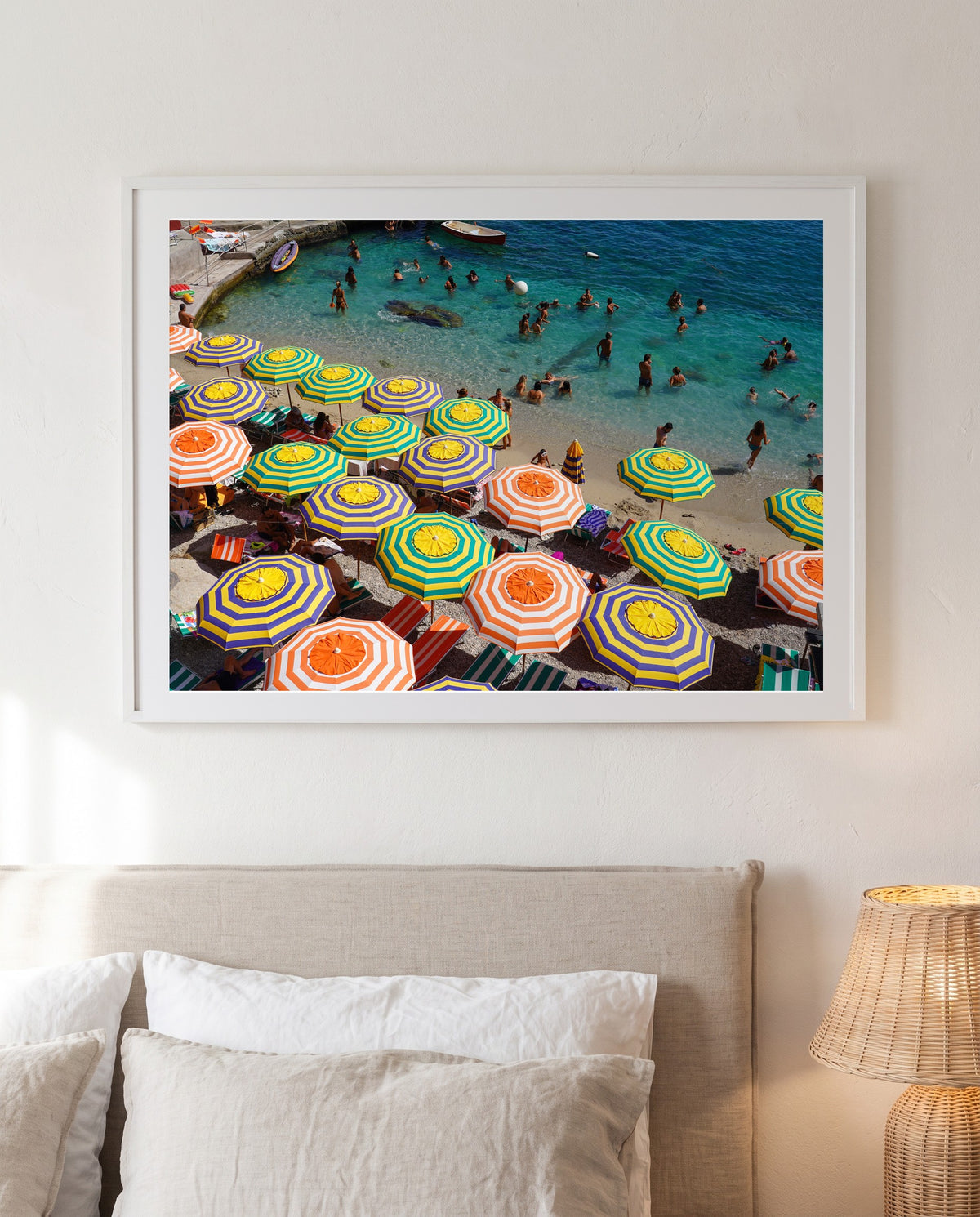
Shades of Capri, framed above a linen bed. A landscape print centred over the bedhead is the simplest way to get the proportion right.
Size guide for common Australian furniture
The table below uses typical Australian furniture widths. Approximate widths include the 5 cm border on each side but not the frame, so treat them as a guide and confirm with the tape test further down. "L" means a landscape print (wider than tall) and "P" means portrait.
| Furniture or wall | Typical width | Target art width | Single print | Pair or alternative |
|---|---|---|---|---|
| Two-seater sofa | about 160 cm | 95 to 120 cm | 66 × 87 L (about 97 cm) | Two 47 × 66 P (about 120 cm with gap) |
| Three-seater sofa | about 220 cm | 130 to 165 cm | 83 × 118 L (about 128 cm) or 100 × 150 L (about 160 cm) | Two 66 × 87 P (about 158 cm with gap) |
| Modular or chaise sofa | 280 to 320 cm | 185 to 230 cm | 100 × 150 L (about 160 cm), works but reads a little small | Two 83 × 118 P (about 194 cm) or two 66 × 87 L (about 202 cm) |
| Queen bed | about 153 cm (bedhead often wider) | 100 to 115 cm | 66 × 87 L (about 97 cm) | Two 47 × 66 P (about 120 cm with gap) |
| King bed | bedhead about 183 to 203 cm | 120 to 150 cm | 83 × 118 L (about 128 cm); 100 × 150 L for the wider bedheads | Two 66 × 87 P (about 158 cm with gap) |
| Sideboard or buffet | 150 to 180 cm | 100 to 120 cm | 66 × 87 L (about 97 cm) or 83 × 118 P (about 93 cm, check height) | Two 47 × 66 P (about 120 cm with gap) |
| Dining table wall | 180 to 240 cm table | 120 to 160 cm | 83 × 118 L or 100 × 150 L | Two 66 × 87 P |
| Entry console | 90 to 120 cm | 60 to 80 cm | 47 × 66 P (about 57 cm) or 66 × 87 P (about 76 cm) | One piece usually reads best here |
| Hallway | narrow, viewed up close | Scale to the wall section | 47 × 66 or 66 × 87 P | A row of 30 × 42 or 47 × 66 prints at a consistent centre height |
| Stairwell | tall void, viewed from below and above | Go large | 83 × 118 P or 100 × 150 | Two or three 47 × 66 prints stepped with the stairs |
| Bedside or small nook | under 80 cm of wall | 40 to 55 cm | 30 × 42 or 47 × 66 | One piece per bedside, matched |
Our print pairs, the Riviera Pair, Milos Pair and Sardinia Pair, are chosen to hang together and cost about 30 per cent less than buying the two prints separately. For a deeper look at hanging two pieces, see how to style a pair of prints.
Portrait or landscape?
Orientation follows the photograph, so some Contemplo prints are landscape and some are portrait. The shape of the wall usually decides it:
- Wide, low furniture (sofas, beds, sideboards) wants a landscape print, or two portrait prints side by side. A single portrait print over a three-seater almost always looks too narrow.
- Tall, narrow walls (beside a doorway, between windows, the end of a hallway, a stairwell) suit portrait prints, which draw the eye upward.
- Short walls under a window or a low ceiling are kinder to landscape prints, which keep the top edge low.
Portrait prints include When the Coast Illuminates, Dropping Anchor and Catch the Breeze. Landscape options include Sardinia, Lake Como and Where Skies Turn Gold.
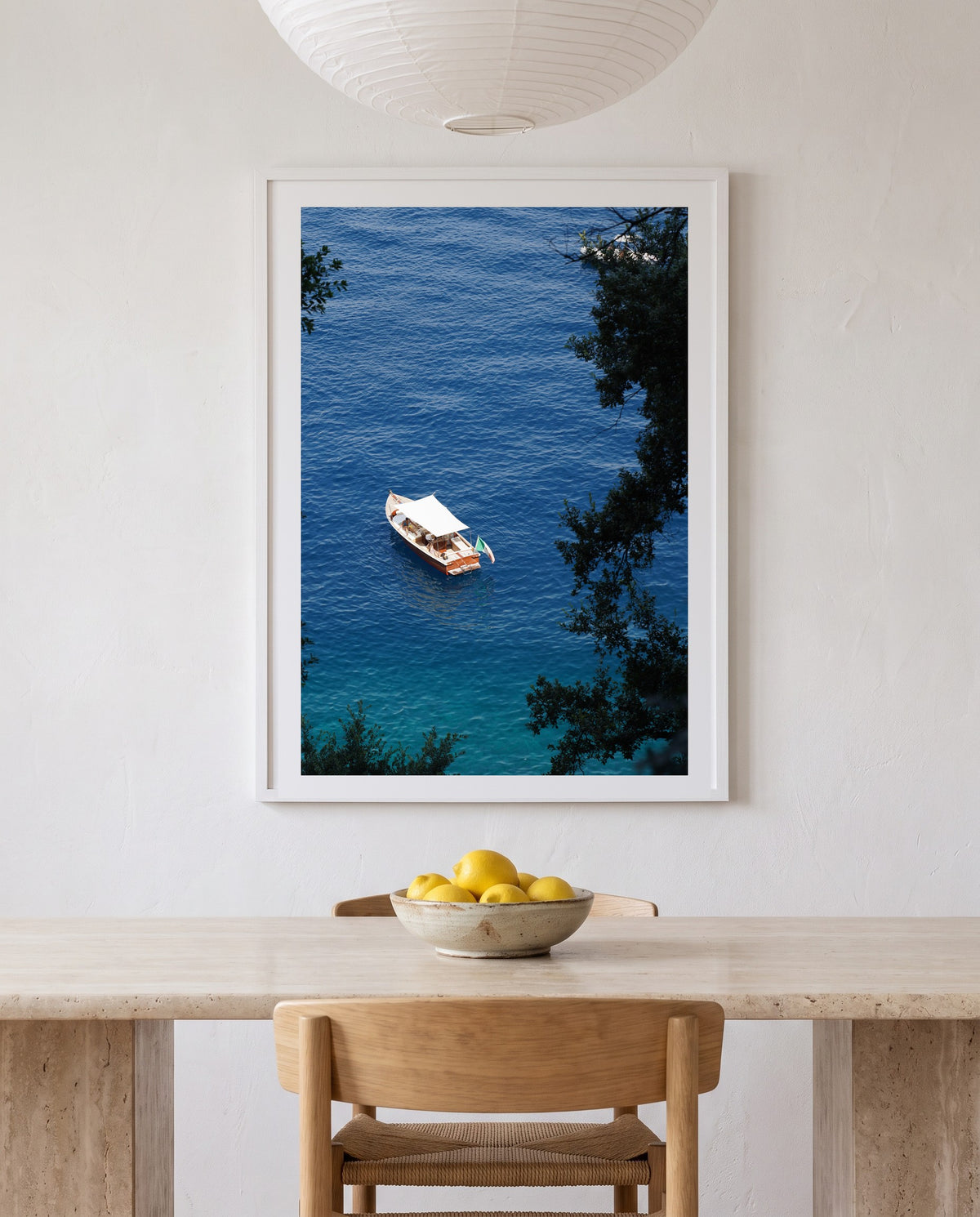
Dropping Anchor, framed above a travertine dining table. Portrait prints suit walls where you have height to spare.
Ceiling height changes the answer
Width is only half the story. Many Australian homes, particularly older houses and project homes, have 2.4 m ceilings. Newer builds and renovations often have 2.55 m or 2.7 m, and some have more. The taller the ceiling, the taller the art can be.
Here is how to check. Most sofa backs sit around 80 to 90 cm off the floor, and you want the bottom of the frame about 20 to 25 cm above that, so the bottom edge lands at roughly 105 to 110 cm.
- A 83 × 118 cm portrait print is about 128 cm tall with its border, plus the frame. Starting at 108 cm, the top edge sits at roughly 236 cm or more. On a 2.4 m ceiling that leaves almost no breathing room, and it will feel cramped. On a 2.7 m ceiling it looks deliberate.
- A 83 × 118 cm landscape print is about 93 cm tall with its border, so the top edge sits at roughly 201 cm plus frame. That leaves plenty of space even on a 2.4 m ceiling.
- Bedheads vary a lot, from about 100 cm to 130 cm or more for upholstered styles. With a tall bedhead on a 2.4 m ceiling, a 66 × 87 cm landscape print is usually safer than an 83 × 118 cm.
As a rough guide, aim to leave at least 25 to 30 cm between the top of the frame and the ceiling. If you can't, go landscape or step down a size.
How to measure, step by step
- Measure the furniture width at its widest point (for a bed, measure the bedhead, not the mattress).
- Multiply by 0.67 to get your target art width. Note the 60 and 75 per cent figures too, so you have a range.
- Measure the height available. From the top of the sofa back or bedhead, add 20 to 25 cm for the gap, then measure from there to the ceiling. Subtract 25 to 30 cm for breathing room at the top. That's your maximum art height.
- Check for obstacles: light switches, power points, wall lights, air-conditioning heads and window frames all limit how wide or tall you can go.
- Pick the size from the table above that fits both your width range and your maximum height. If two sizes fit, the bigger one is usually right.
- Test it on the wall with tape or paper before you order (see below).
Test it with painter's tape or a paper template
This is the single most useful thing you can do, and it takes ten minutes.
- Painter's tape: mark the outline of the size you're considering on the wall, allowing for the white border and a few centimetres of frame. Use a level for the top and bottom lines. Low-tack painter's tape comes off cleanly from most painted walls.
- Paper template: tape sheets of butcher's paper or flattened cardboard together to the full size and stick it up. This is better than tape alone because it shows you the block of colour the art will create.
- Live with it for a day. Look at it from the doorway, from the sofa and at night under lamplight. If you're torn between two sizes, tape both and compare.
You can also upload a photo of your wall to our wall tool to try prints and sizes. It's a quick guide rather than an exact scale drawing, because phone photos distort distance. For true scale, send us a photo of your wall with its width and we'll mock up any print for free.
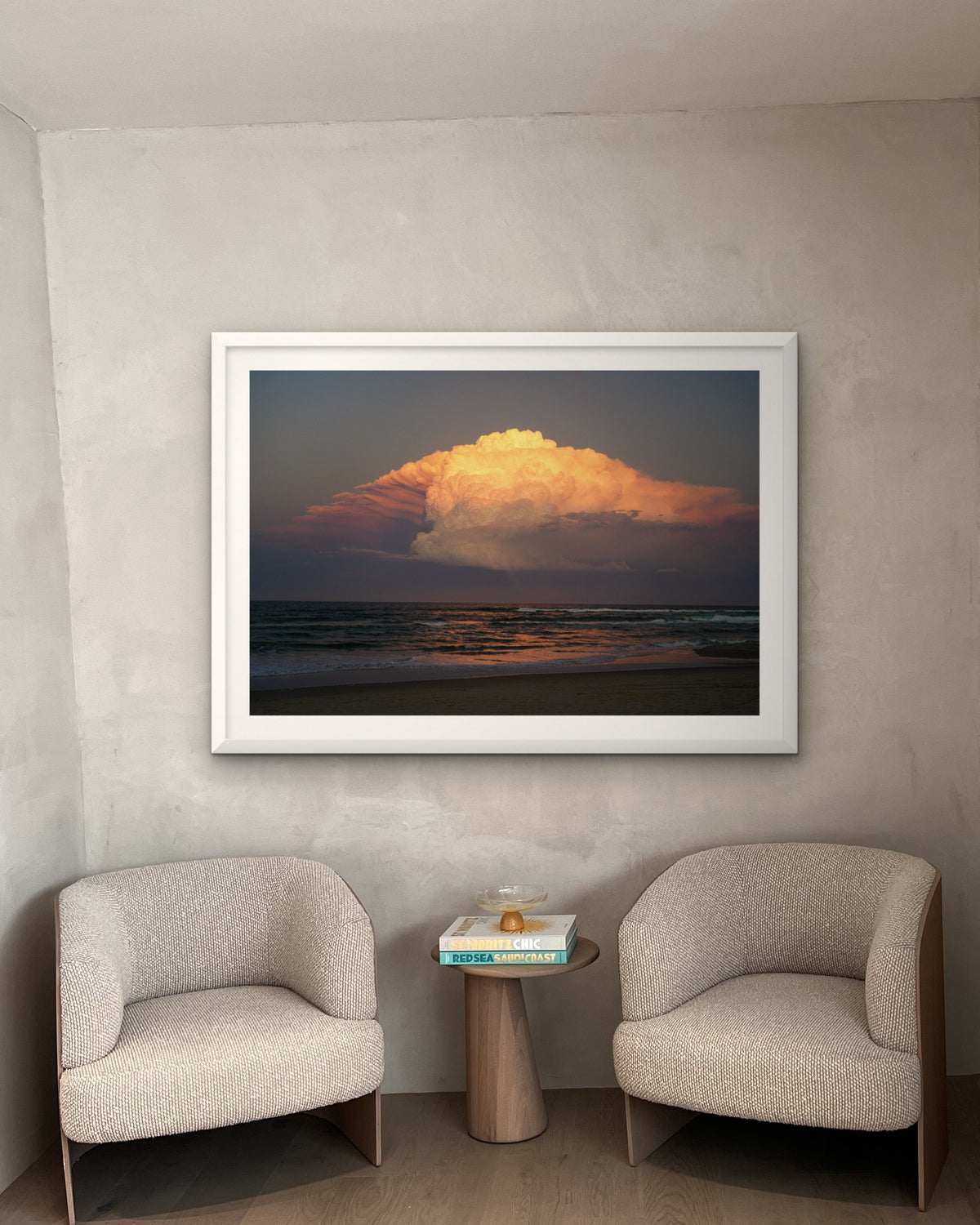
Where Skies Turn Gold, framed, in a room. A landscape print keeps plenty of space above it, even on a standard ceiling.
Common sizing mistakes
- Going too small. A 30 × 42 cm print over a three-seater sofa will look lost. Small sizes belong on small walls, bedsides, desks and groupings.
- Going wider than the furniture. Art that overhangs the sofa or bedhead looks top-heavy. Keep it inside the furniture's width, ideally with at least 15 to 20 cm to spare each side.
- Ignoring the border and frame. The image size is not the size on the wall. Add the 5 cm border on each side, then the frame.
- Forgetting the ceiling. A tall portrait print on a 2.4 m ceiling above a high-backed sofa can run out of room.
- Hanging too high. Even the right size looks wrong when it floats a metre above the sofa. Keep the gap to 20 to 25 cm. Our guide to how to hang wall art covers heights and spacing in detail.
- Centring on the wall instead of the furniture. If your sofa isn't centred on the wall, centre the art on the sofa.
- Too many small pieces. Unless you're deliberately building a gallery wall, one large print or a well-matched pair usually reads better than four or five small ones.
Checklist
- Furniture width measured, target art width worked out at about two-thirds.
- Border (5 cm each side) and frame allowed for in your sums.
- Maximum height checked against your ceiling, leaving 25 to 30 cm at the top.
- Landscape for wide, low furniture; portrait or a pair for tall or long walls.
- Outline taped or a paper template up for at least a day.
For walls that call for something really big, our guide to large wall art in Australia goes further, and framed or unframed explains what changes when you frame.
Shop the edit


Frequently asked questions
What size art should go above a 3 seater sofa?
For a typical 220 cm three-seater, aim for art about 130 to 165 cm wide. That's a single 83 × 118 cm or 100 × 150 cm landscape print, or a pair of 66 × 87 cm portrait prints hung with a 5 to 8 cm gap.
What size art goes above a king bed?
King bedheads are usually about 183 to 203 cm wide, so aim for 120 to 150 cm of art. An 83 × 118 cm landscape print suits most king beds, a 100 × 150 cm landscape print suits the wider bedheads, and two 66 × 87 cm portrait prints work well as a pair. Check your ceiling height if the bedhead is tall.
Should wall art be wider than the sofa?
No. Art wider than the furniture below looks top-heavy. Keep it to about two-thirds of the furniture's width, and never more than about 75 per cent.
Is it better to have one big print or two smaller ones?
Both work. One large print is calmer and more striking. A pair suits very long furniture such as modular sofas, and it lets you go wide without going tall, which helps on 2.4 m ceilings.
What size art for a hallway?
Hallways are viewed up close, so medium sizes such as 47 × 66 cm or 66 × 87 cm portrait prints usually feel right. For a long hallway, hang a row of smaller prints at the same centre height.
Can art be too big for a room?
Yes, if it's wider than the furniture, crowds the ceiling or covers switches and windows. Taping the outline on the wall first is the easiest way to find out before you order.
Not sure which size? Send us a photo of your wall and we'll mock up any print at true scale, free. Request a free mock-up or try the wall tool.
Whether it's a Queenslander living room in Brisbane, a Melbourne terrace or a Perth beach house, the same rules apply: measure the furniture first, then size up. Every print is made to order on the Gold Coast and delivered Australia-wide.