The short answer
Mediterranean interior style comes down to five things: warm limewash or plaster walls, natural materials (linen, timber, terracotta, stone, rattan), a sun-washed palette of sand, terracotta, olive and sea blue, curved soft shapes, and one or two pieces of art that bring the sea into the room. In an Australian home, start with the walls and the art, because they set the mood for everything else. Choose one large coastal photograph per wall rather than lots of small pieces, sized to about two-thirds of the furniture below it.
Mediterranean style is having a long moment in Australia, and it is easy to see why. Our light, our coastline and the way we live outdoors for much of the year already have a lot in common with the Amalfi Coast, the Greek islands and Sardinia. The look suits a Queensland weatherboard, a Sydney apartment and a new build on the Gold Coast equally well, as long as you get the fundamentals right.
This guide breaks Mediterranean interior style into practical decisions: which colours to paint, which materials to buy, how to style each room, how to choose and size art, and the common mistakes that make a room look like a themed restaurant instead of a calm coastal home. It also covers the three regional flavours (Italian, Greek and Sardinian) so you can pick the one that suits your house.
What Mediterranean interior style actually is
Mediterranean style is not a single look. It is a family of looks from the coasts of southern Europe that share a few traits: they were built for heat and bright sun, they use local, handmade materials, and they are designed around the view and the outdoors. Thick walls, small shaded windows, cool floors and simple furniture all come from practical needs.
The modern version that suits Australian homes keeps the warmth and texture but drops the heavy, dark furniture and ornate wrought iron that defined the 1990s "Tuscan" trend. Think lighter, calmer and more relaxed: a lime-washed wall, a curved linen sofa, a timber table, an olive tree in a terracotta pot and a big photograph of turquoise water.
The three regional flavours
| Style | Palette | Materials | Art that suits it |
|---|---|---|---|
| Italian coastal (Amalfi, Capri, Positano, Portofino) | Warm plaster, terracotta, lemon, deep sea blue, crisp white | Glazed tile, travertine, walnut, striped linen | Colourful cliff towns, beach clubs and umbrellas, boats from above |
| Greek island (Milos, Paros, Santorini) | Chalk white, sand, Aegean blue, soft grey | Whitewashed render, pale oak, rope, raw linen | White volcanic rock, clear turquoise coves, dramatic caldera cliffs |
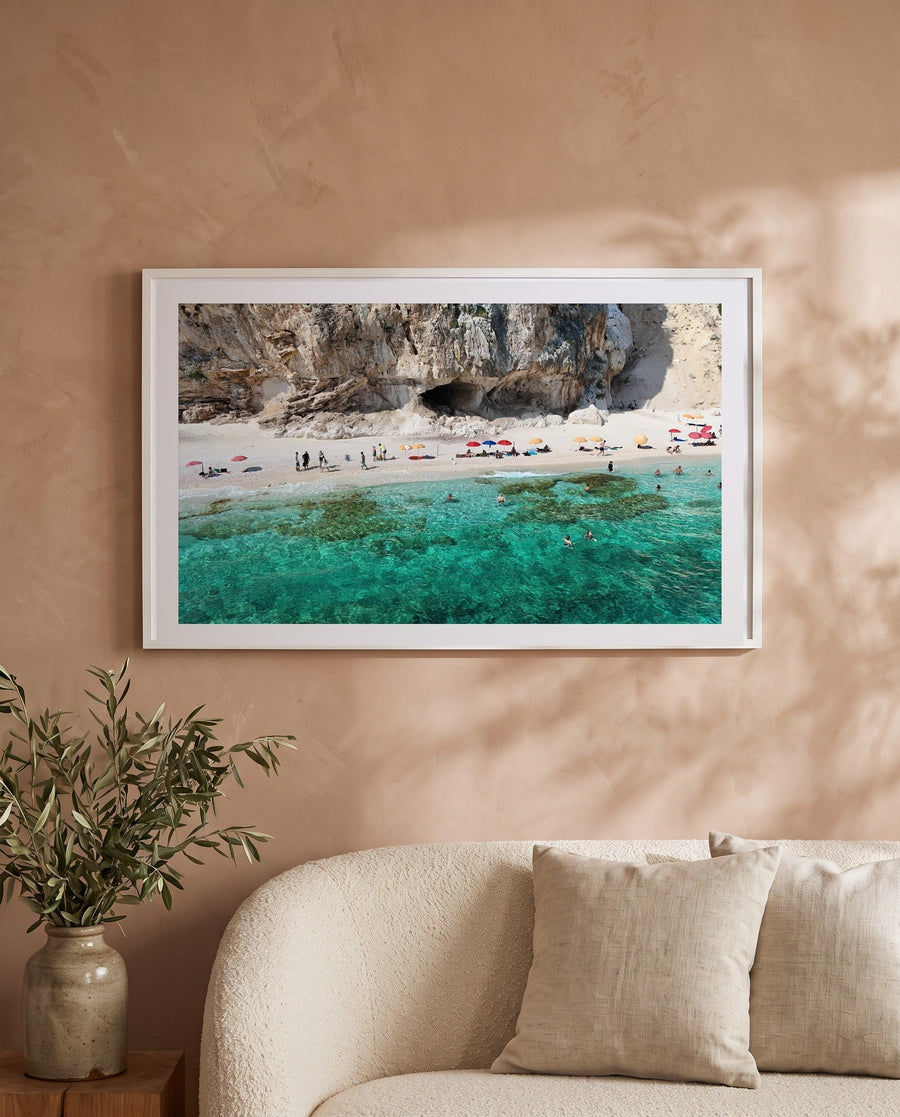
| Sardinian (Costa Smeralda, Gulf of Orosei) | Granite pink, emerald, ivory, olive | Stone, rough plaster, juniper timber, woven baskets | Aerial coves, pink granite, emerald shallows |
You don't need to choose one strictly. Many of the best rooms blend them, for example Greek white walls with Italian terracotta floors. What matters is keeping the palette tight and the materials natural.

A warm plaster wall, a curved boucle sofa and an olive branch: the Mediterranean look in three moves. Shown: Sun, Style, Beachclubs - Capri.
Step 1: Get the walls right
Walls do more work in a Mediterranean room than in almost any other style. Flat, cool white paint will make the room feel generic, no matter what you put in it.
- Limewash or mineral paint gives the soft, cloudy movement of old plaster. It is the single most effective change you can make. It works best in warm terracotta, peach, sand or warm white.
- Textured render or Venetian plaster suits feature walls behind a sofa or bed. It is more expensive but lasts for years.
- Warm whites are the safe choice for Greek-leaning rooms. Look for whites with a yellow or red undertone rather than blue or grey, which can look cold in strong Australian light.
- Sun-baked colours such as terracotta, clay pink or peach suit Italian and Sardinian rooms. Use them on one wall first if you are unsure.
A textured, warm wall also makes art look better. Photographs of sea and sky stand out beautifully against peach and sand, because blue and turquoise sit opposite warm orange on the colour wheel. For more on this, see our guide to choosing art colours for your room.
Step 2: Choose natural materials
Mediterranean homes use what was local: stone, clay, timber and natural fibre. In practice that means:
- Floors: terracotta tiles, honed travertine, limestone-look porcelain or wide oak boards. Polished concrete works if you warm it up with rugs.
- Furniture: solid timber tables, rush or rattan chairs, curved upholstered sofas in linen or boucle.
- Textiles: washed linen, cotton and wool. Stripes, simple checks and plain weaves, not busy florals.
- Accessories: handmade ceramics, terracotta pots, woven baskets, olive or fig branches in a vase, a few books.
- Metals: aged brass or black iron in small doses, for example a pendant or cabinet handles.
The rule of thumb: if it looks handmade, sun-faded or slightly imperfect, it probably belongs. High-gloss finishes, chrome and mirrored furniture usually don't.
Step 3: Use art to bring the sea indoors
The real Mediterranean is defined by its water: impossible turquoise, deep cobalt and the white flash of rock. Because most of us can't look out the window at the Tyrrhenian Sea, art is how you bring that colour and light into the room. It is also the element that turns a beige room with a few rattan pieces into something that genuinely feels like the coast.
What kind of art works
- Coastal photography from the Mediterranean itself is the most natural fit. It carries the real colours of the water and the real light, which paintings and prints of generic beaches can't match.
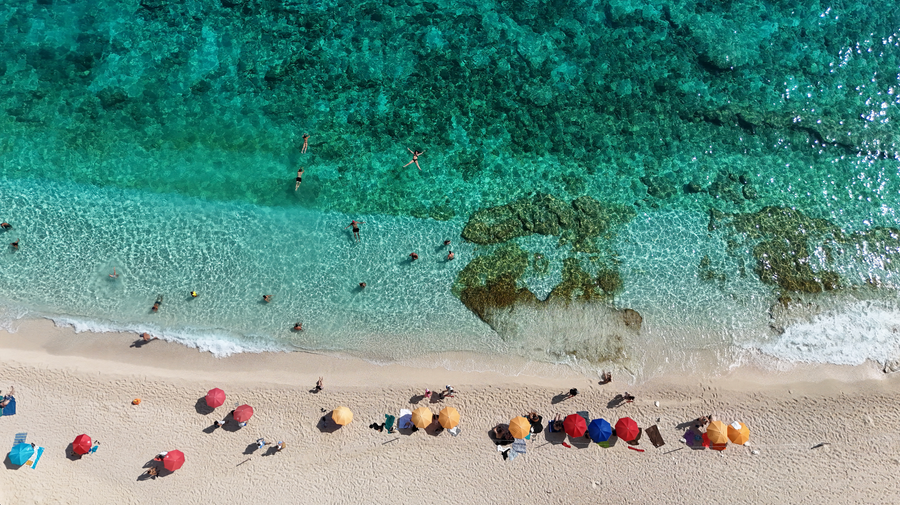
- Aerial images suit modern, minimal rooms. Seen from above, a beach becomes an almost abstract pattern of colour, which sits well with clean lines and plaster walls. Our From Above collection is built around this.
- Village and cliff scenes such as Positano's stacked houses suit Italian-leaning rooms with more colour and pattern.
- Rock and water studies, like the white cliffs of Milos, suit calm Greek-style rooms with lots of white.
One big piece beats many small ones
Mediterranean rooms are uncluttered. A single large print above the sofa, bed or dining table reads as calm and confident. A cluster of small frames reads as busy, which works against the style. If you want more than one image, use a matched pair with even spacing rather than a mixed gallery wall. Our guide to styling a pair of prints covers spacing in detail.

Not every Mediterranean room needs a beach. Cypress greens and a lakeside villa suit olive and sage palettes. Shown: Lake Como.
Step 4: Size the art properly
Undersized art is the most common mistake in any room, and it is especially noticeable against a textured wall. Use these rules:
- Above furniture: aim for art about two-thirds the width of the sofa, bed or sideboard below it.
- Height: leave roughly 15 to 25 cm between the top of the sofa back or bedhead and the bottom of the frame.
- Freestanding walls: hang so the centre of the image sits around 145 to 155 cm from the floor.
Worked example
You have a 2.2 metre curved sofa against a limewashed wall. Two-thirds of 220 cm is about 147 cm. That points to our 100 × 150 cm size (image size, plus a 5 cm white border on every side), which fills the wall properly. If your ceiling is low or the wall is narrow, the 83 × 118 cm size is the next step down. For a 1.8 metre sofa, two-thirds is 120 cm, so 83 × 118 cm is the natural choice.
Every Contemplo product page has a "See it to scale" view that shows your chosen size above a 2.2 metre sofa, so you can check before you buy. For a full breakdown by furniture, read what size art to hang above a sofa or bed.
| Image size (cm) | Best for | Unframed | Framed |
|---|---|---|---|
| 30 × 42 | Shelves, bedside walls, bathrooms, small nooks | $169 | $389 |
| 47 × 66 | Above a console, beside a window, in a pair above a bed | $229 | $539 |
| 66 × 87 | Above a queen bed or a 1.5 m sideboard | $279 | $699 |
| 83 × 118 | Above a 1.8 m sofa, king bed or dining table | $329 | $999 |
| 100 × 150 | Above a 2.2 m+ sofa, a long dining table or a feature wall | $499 | $1,459 |
Prices are in AUD and include GST. Delivery is free Australia-wide on every print.
Step 5: Pick a frame that suits the style
Mediterranean rooms suit simple frames. Our standard framed option is a white timber frame with a 5 cm white border around the image, which echoes whitewashed walls and keeps the focus on the water. It works with almost every Mediterranean palette, from Greek white to terracotta.
If your room leans warmer, with walnut, terracotta and darker timbers, a natural oak or black frame can be quoted on request. For rooms with a lot of glare from windows or skylights, ask about non-reflective glass. At 83 × 118 and 100 × 150 cm, framed prints use shatter-resistant acrylic and a deeper 45 mm frame. There is more detail on our framing page and in framed vs unframed prints.
Room by room: the Mediterranean look
Living room
Start with a curved sofa in cream or oatmeal linen or boucle, a low timber or travertine coffee table, a jute or wool rug and one large print above the sofa. Add an olive tree in a terracotta pot by the window and a couple of handmade ceramic pieces. Keep cushions to two or three, in plain linen or a simple stripe.
Dining room
A long timber table with rush or rattan chairs is the classic Mediterranean set-up. Hang a landscape-format print centred over the table, about two-thirds of the table's length. A woven or plaster pendant and a large ceramic bowl in the centre of the table finish it.

A long oak table, rush chairs and an aerial view of the Italian Riviera. Shown: Portofino From Above.
Bedroom
Mediterranean bedrooms are calm and pale: white or sand walls, layered linen bedding, a woven pendant and a simple timber or upholstered bedhead. Above the bed, either one landscape print about two-thirds the bed's width, or a pair of portrait prints. Choose soft, quiet images here, such as pale rock and clear water, rather than busy scenes.

Greek island calm: two portrait prints, white walls and a jute rug. Shown: the Milos Pair.
Entry and hallway
A narrow console in timber or stone, a ceramic lamp and a medium print (47 × 66 or 66 × 87 cm) is enough to set the tone as soon as people walk in. Our hallway art guide covers narrow walls and sightlines.
Bathroom
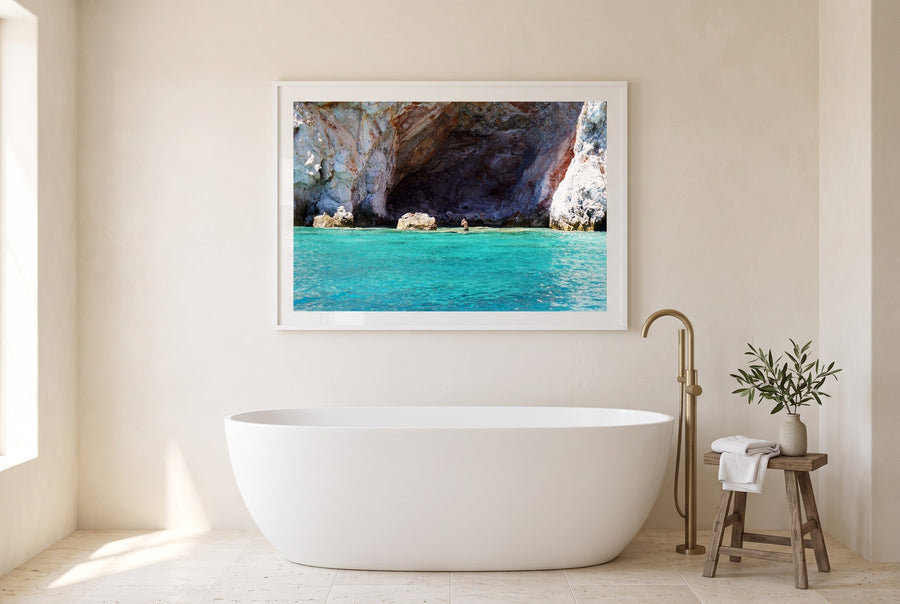
Terracotta or zellige-style tile, a stone basin and a small framed print on a wall away from direct splashes. Keep humidity in mind: a well-ventilated bathroom is fine for a framed print, but avoid the wall right beside the shower.
Checklist
- Walls in a warm white, sand, peach or terracotta, ideally limewash or textured
- At least three natural materials in each room (timber, linen, stone, terracotta, rattan)
- A tight palette: two base colours plus one sea-blue or olive accent
- One large coastal print per main wall, about two-thirds the width of the furniture below
- Simple white or natural timber frames
- Living greenery: olive, fig or a trailing plant in terracotta
- Curved shapes somewhere: a sofa, an arched mirror or a round table
- Clutter cleared from surfaces, leaving space to breathe
Common mistakes to avoid
- Going "Tuscan". Dark timber, heavy scrolled iron and faux-aged finishes date a room quickly. Keep it light and relaxed.
- Cool grey walls. Blue-grey whites fight the warmth of terracotta and timber. Choose warm undertones.
- Too many accessories. Five ceramic pots, three baskets and a gallery wall will tip into clutter. Edit hard.
- Generic beach art. Starfish and "beach life" signs say holiday rental, not Mediterranean home. Real coastal photography from the region looks more considered.
- Art that is too small. A 30 × 42 cm print floating above a 2.2 m sofa looks lost. Size up.
- Ignoring the light. Strong afternoon sun can fade unframed prints and wash out colour. Hang important pieces away from direct sunlight, or consider UV-filtering glass.
Making it work in Australian homes
The good news is that most Australian houses already suit the style. A few tips specific to our climate and housing:
- Our light is stronger. Colours that look soft in Europe can look washed out here, and pure whites can glare. Warm, slightly deeper tones hold up better, especially in north-facing rooms.
- Humidity matters in Queensland and northern NSW. Choose framed prints for living areas near the coast, keep air flowing, and see our guide to caring for prints in coastal and humid homes.
- Renting? You can still get the look with linen, rugs, plants and art. Our guide to hanging art in a rental without drilling covers the options.
- New builds often have plain plasterboard walls and grey floors. A limewash feature wall, a jute rug and a big piece of coastal art will warm them up faster than anything else.
A Mediterranean room on three budgets
| Budget | What to do | Art suggestion |
|---|---|---|
| About $500 | Swap cushions and throws to linen, add an olive tree in terracotta, add one print | An unframed 66 × 87 cm print ($279) in a frame you already own, or a 47 × 66 cm framed print ($539) |
| About $1,500 | Limewash one feature wall, add a jute rug and a ceramic lamp, frame one large print | A framed 83 × 118 cm print ($999) |
| About $3,000+ | New curved sofa or timber dining table, plaster wall, statement art | A framed 100 × 150 cm print ($1,459) or a framed pair |
Spending $700 or more on prints? Add any 30 × 42 cm unframed print to your cart and it is free with your order. It is a good way to bring a smaller image into a bathroom or bedside nook to match. See the free print offer for details.
Shop the edit


Browse the full Italian Summer, Greek Islands and Sardinia collections for more.
Frequently asked questions
What colours are used in Mediterranean interiors?
Warm whites, sand, terracotta, peach and clay for walls and floors, with accents of sea blue, turquoise, olive green and occasionally lemon yellow. Keep it to two base colours and one or two accents for a calm, modern result.
What is the difference between Mediterranean and coastal or Hamptons style?
Hamptons style is crisp and tailored, with navy, white, panelled walls and polished finishes. Mediterranean is warmer and more rustic, with plaster walls, terracotta, raw timber and handmade pieces. Both love the sea, but Mediterranean feels sun-baked rather than nautical.
What wall art suits a Mediterranean style home?
Large coastal photography from the Mediterranean itself works best: turquoise coves, white island rock, colourful cliff villages and aerial beach scenes. Choose one large piece per wall, in a simple white or natural timber frame.
Can I do Mediterranean style in a small apartment?
Yes. Keep the palette pale, use one limewashed or warm wall, bring in linen and a plant, and hang one well-sized print rather than several small ones. A big image of open water can make a small room feel larger.
Is Mediterranean style suitable for a humid Queensland home?
Very much so, since the style was designed for heat. Choose framed prints for art, keep rooms ventilated, and favour tile, stone and linen, which handle humidity well.
Want to see it on your wall first? Send us a photo of your space and we'll mock up any print at true scale, free of charge. Request a free mock-up or try the wall tool.
← Older post Newer post →