The short answer
Choose art that is about two-thirds the width of your console or sideboard (anywhere from 60% to 75% looks right), and hang it so the bottom of the frame sits 15 to 25 cm above the top surface. For a 120 cm console that means art roughly 75 to 90 cm wide; for a 180 cm sideboard, roughly 110 to 135 cm wide. Narrow consoles suit a portrait print, long sideboards suit one large landscape print or a pair. Then style the top in three heights so nothing covers more than the bottom third of the artwork.
Above a console or sideboard, art that is too small floats like a postage stamp, and art that is too large swamps the furniture and fights with the lamp. Here are the exact sizes, heights and layouts, with worked examples, so you can order once and hang it with confidence.
Step 1: Measure the furniture, not the wall
Above a sofa or bed, the wall and the furniture are usually similar widths. Above a console or sideboard, the furniture is the frame of reference. Measure three things:
- Width of the top surface (the widest point, not the legs).
- Height of the top surface from the floor. Most consoles and sideboards sit between 75 and 85 cm. Low media units are usually 45 to 60 cm.
- Depth of the top. This tells you whether leaning is an option. Consoles are often only 30 to 40 cm deep; sideboards are usually 40 to 50 cm.
Then multiply the width by 0.6 and 0.75. That range is the total outside width your artwork should land in, including its border and frame. Two-thirds (0.66) is the sweet spot most designers aim for.
Step 2: Match the print size to your furniture
Our sizes are the image size, and every print has a 5 cm white border on each side, so the paper is 10 cm wider and taller than the image. A 66 × 87 cm print hung landscape is about 97 cm wide on paper, before any frame. Framing adds a few more centimetres. Use the table below as a starting point; all prices are current single print prices.
| Furniture width | Target art width (60 to 75%) | Best single print | Unframed / framed |
|---|---|---|---|
| 80 to 100 cm (slim hall console) | 48 to 75 cm | 47 × 66 cm, portrait (about 57 cm wide on paper) | $249 / $539 |
| 110 to 130 cm (standard console) | 66 to 98 cm | 47 × 66 cm landscape or 66 × 87 cm portrait (both about 76 cm wide) | $249 / $539 or $279 / $699 |
| 140 to 160 cm (small sideboard) | 84 to 120 cm | 66 × 87 cm, landscape (about 97 cm wide) | $279 / $699 |
| 170 to 200 cm (sideboard or buffet) | 102 to 150 cm | 83 × 118 cm, landscape (about 128 cm wide) | $329 / $999 |
| 210 to 240 cm (long sideboard or media unit) | 126 to 180 cm | 100 × 150 cm, landscape (about 160 cm wide) | $499 / $1,459 |
At 83 × 118 and 100 × 150 cm, framed works use shatter-resistant acrylic and a deeper 45 mm frame. At 100 × 150 cm we recommend framed: it arrives ready to hang, and a custom frame that large is costly to source locally. If you want help with the whole sofa and bed side of the house too, our wall art size guide covers those with the same method.

A portrait print over a narrow surface: Dropping Anchor. The same proportions work above a slim hall console.
Step 3: Portrait, landscape or a pair?
Portrait: slim consoles and tall walls
If your console is under about 110 cm wide, a landscape print big enough to look intentional is usually too wide. Turn it portrait. A tall print also draws the eye up, which helps in entries and hallways with high ceilings. Portrait images in our range include Catch the Breeze, When the Coast Illuminates, Lifeguard's Life, Paros and The Arch of Milos.
Landscape: sideboards and buffets
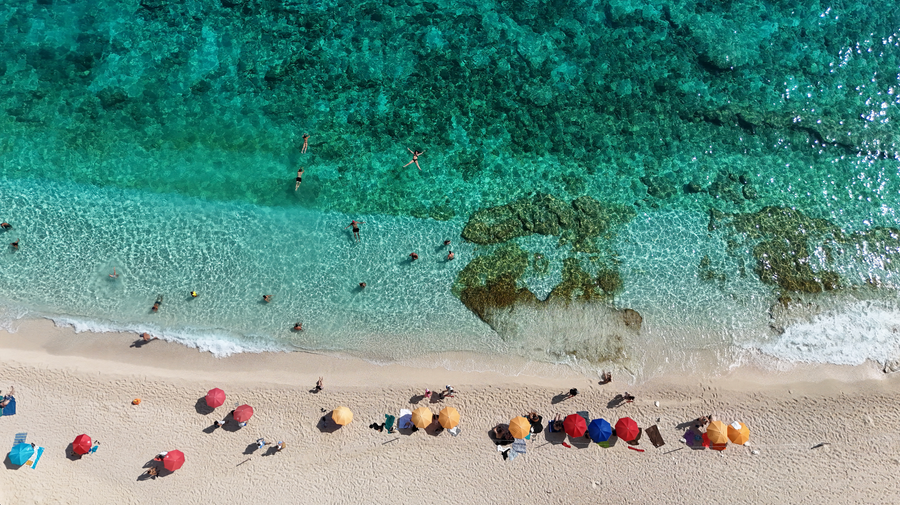
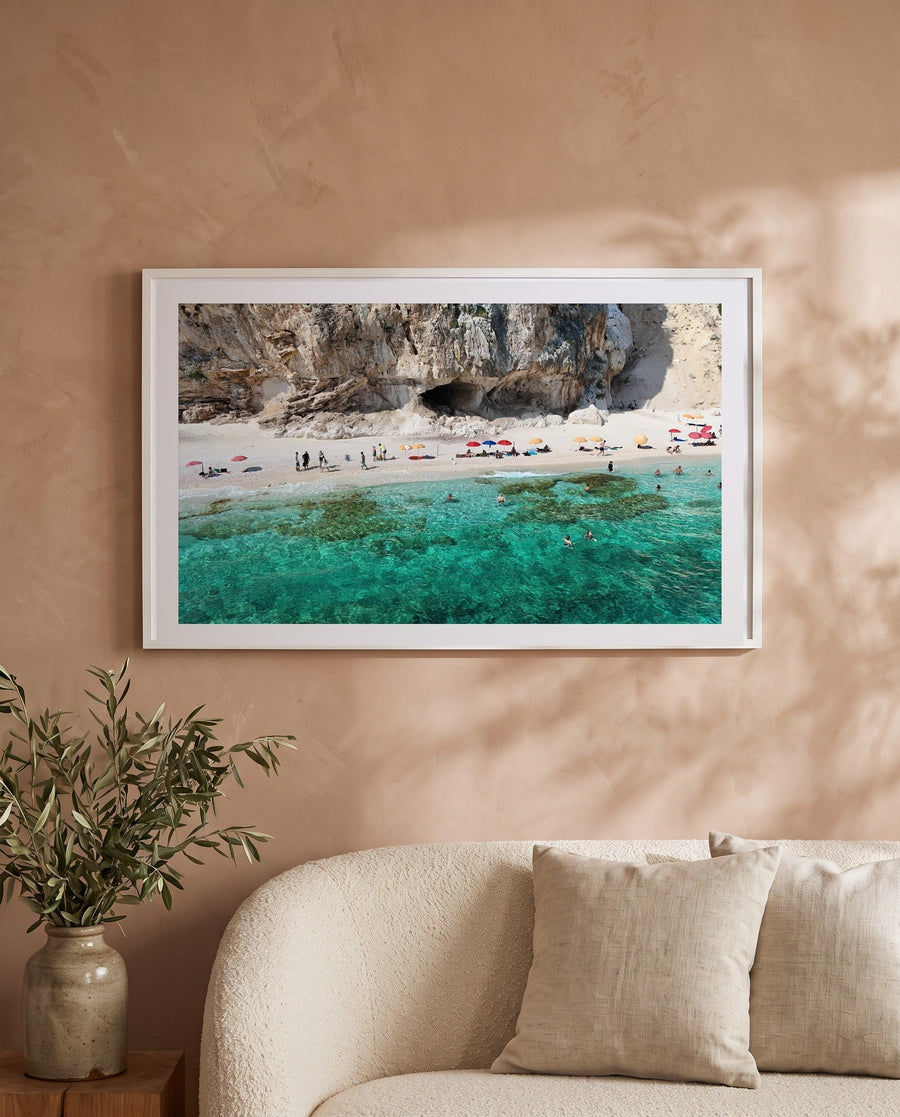
Sideboards are long and low, so a landscape print echoes their shape. Aerial photographs are especially good here, because they read as calm, wide fields of colour that sit comfortably over a styled surface. Look at our From Above collection and the Sardinia collection, which are mostly wide formats.

A wide landscape print over long furniture: Portofino From Above. A sideboard of similar length takes the same size.
A pair: long sideboards and media units
Two prints side by side fill a long piece of furniture without the cost or weight of one very large frame. Keep the gap between them at 5 to 10 cm and treat the pair as one unit when you measure: the total width (both pieces plus the gap) should still be 60 to 75% of the furniture.
- Two 47 × 66 cm portrait prints with an 8 cm gap measure about 122 cm across on paper, which suits a 160 to 200 cm sideboard.
- Two 66 × 87 cm portrait prints with an 8 cm gap measure about 160 cm across, which suits a 220 to 240 cm sideboard or media unit.
Our curated pairs (the Sardinia Pair, Milos Pair and Riviera Pair) are priced about 10% less than buying the two prints separately: $449 unframed or $969 framed at 47 × 66 cm, and $509 unframed or $1,249 framed at 66 × 87 cm. Our guide to styling a pair of prints goes deeper on spacing and choosing images that talk to each other.

Two prints read as one wide piece when the gap is tight: the Sardinia Pair.
Step 4: Get the height right
The gallery rule of centring art at 145 to 150 cm from the floor applies to open walls. Over furniture, the furniture wins: the art should look connected to it, not floating above it.
- Gap above the furniture: 15 to 25 cm from the top surface to the bottom of the frame. Go to the lower end with a smaller print, and to the upper end if you have tall lamps or a large vase.
- Centre point: it will usually land between 135 and 160 cm from the floor. If your calculation puts it above 165 cm, the print is probably too small or hung too high.
- Low media units: with a 50 cm high unit, the bottom of the frame can sit 20 to 30 cm above the top, or higher if a TV sits there (in which case hang the art beside the TV rather than above it).
Worked example: 180 cm sideboard
The sideboard is 180 cm wide and 80 cm high. Two-thirds of 180 is 120, so the 83 × 118 cm print hung landscape (about 128 cm wide on paper, a little more framed) is right at about 71%. The paper is about 93 cm tall. Leave 20 cm above the sideboard, so the bottom of the frame sits at 100 cm. The centre is 100 + 46.5 = about 147 cm from the floor, which also happens to be classic gallery height. Framed, this is $999.
Worked example: 100 cm entry console
The console is 100 cm wide and 78 cm high. Two-thirds is 66 cm. A 47 × 66 cm print hung portrait is about 57 cm wide on paper and 76 cm tall: 57% of the console, slightly under the ideal but balanced by its height. Hang the bottom 18 cm above the top, at 96 cm. The centre sits at about 134 cm, a comfortable height for a hallway you walk through rather than sit in. Framed, this is $539.
For the hanging hardware itself (hooks, wire versus D-rings, and getting two hooks level), see how to hang wall art.
Step 5: Lean or hang?
Leaning art on a sideboard looks relaxed and lets you rotate pieces with the seasons. It works when:
- The top is at least 40 cm deep, so the frame can sit at a gentle angle with room for objects in front.
- The piece is framed. Unframed paper should never lean.
- The frame is no wider than the sideboard top and comfortably below the ceiling.
- Nobody is likely to knock it: in homes with small children or large dogs, hang it instead, or secure the top of the frame to the wall.
Put a small non-slip pad under the bottom edge so it can't slide, and lean it against the wall at about 10 to 15 degrees. Our largest framed sizes are deep and heavy with acrylic, so we suggest hanging rather than leaning anything 83 × 118 cm and above on a console.
The layered look
A favourite designer trick is to hang one larger print, then lean a smaller one in front of it, off to one side. A 30 × 42 cm framed print leaning against the wall in front of a hung 83 × 118 cm print adds depth without clutter. Overlap the large one by no more than a quarter of the small one's width, and choose images with a shared colour.
Checklist
- Width of furniture measured, and multiplied by 0.6 and 0.75.
- Print chosen with the 5 cm border (and frame) included in the width.
- Orientation matched: portrait for slim consoles, landscape or a pair for sideboards.
- Bottom of frame 15 to 25 cm above the top surface.
- Centre point checked: usually 135 to 160 cm from the floor.
- Lean only framed works, on a top at least 40 cm deep, with a non-slip pad.
- Styling plan: one tall, one medium, one low object, and nothing covering more than the bottom third of the art.
Step 6: Style the surface around the art
The art and the objects in front of it should be planned together. A simple formula that works almost every time:
- One tall element to one side: a table lamp, a branch in a vase, or a tall ceramic. It can overlap the edge of the frame by a few centimetres, which links the two.
- One medium element on the other side: a stack of two or three books with a small object on top, or a bowl.
- One low element in the middle or just off-centre: a tray, a candle, a dish for keys.
Asymmetry looks collected and relaxed. Symmetry (matching lamps either side of a centred print) looks formal and suits dining rooms and traditional homes.
Lamps and glass
A table lamp right in front of glazed art can bounce a bright spot off the glass in the evening. Move the lamp slightly off to the side, or choose a shade that throws light down rather than out. If the sideboard faces a window, Non-Reflective, UV Clear or Museum UV Non-Reflective glass are available on request (museum glass blocks 70% of UV with under 1% reflection). See framing details for the options.
Common mistakes
- Art wider than the furniture. Above a console, art should never overhang the ends. It looks top heavy and unsettled.
- Hanging at eye height regardless of the furniture. A 60 cm gap between sideboard and frame breaks the connection. Bring it down.
- Too small a print, made "bigger" with clutter. If the art is undersized, more objects won't fix it. Size up, or use a pair.
- Forgetting the border. Our prints carry a 5 cm white border on every side, so the paper is 10 cm wider than the image size. Measure with that included.
- Covering the subject. A lamp or vase sitting right over the focal point of the photograph makes it look like an afterthought.
- Centring on the wall instead of the furniture. If the sideboard is off-centre on the wall, centre the art on the sideboard, so they read as one composition.
Choosing the image
A console or sideboard is usually in a passing space: an entry, a hallway, the edge of a dining room. Pick something that reads instantly from a distance. Strong single subjects work well (the Faraglioni Rocks seen from the bow of a boat, or the cypress-lined villa in Lake Como). In an entry, a warm sunset tone such as When the Coast Illuminates makes a welcoming first impression. If your entry is also a long corridor, our hallway and entryway guide covers runs of prints along a wall.
Ordering, delivery and the current offer
Every print is made to order on archival fine art paper and finished by hand on the Gold Coast. Production takes 5 to 10 business days (framed a little longer), and the product page shows an estimated arrival date for the finish you choose. Unframed prints ship free Australia-wide with tracking. Framed works are wrapped, boxed and fully insured, with delivery charged at cost and shown at checkout.
If your sideboard plan adds up to $700 or more in prints, for example a framed 83 × 118 cm print with a framed 47 × 66 cm portrait for the entry, you can add any 30 × 42 cm unframed print and it becomes free automatically. It's one per order and can't be combined with discount codes such as WELCOME10. The full terms are on the free print offer page.
Shop the edit


Frequently asked questions
What size art should go above a 120 cm console table?
Aim for 72 to 90 cm wide in total. A 47 × 66 cm print hung landscape, or a 66 × 87 cm print hung portrait, is about 76 cm wide on paper including our 5 cm border, which is right in that range.
How high should art be hung above a sideboard?
Leave 15 to 25 cm between the top of the sideboard and the bottom of the frame. On a standard 75 to 85 cm high sideboard, that usually puts the centre of the art between 135 and 160 cm from the floor.
Should art be wider than the console?
No. Keep it to 60 to 75% of the furniture's width. Art that overhangs the ends of a console looks top heavy. If you need more presence, go taller (portrait) or use a pair.
Can I lean a framed print on a sideboard instead of hanging it?
Yes, if the top is at least 40 cm deep, the piece is framed, and it's out of reach of small children and pets. Use a non-slip pad under the bottom edge. For our 83 × 118 and 100 × 150 cm framed sizes, we suggest hanging rather than leaning.
← Older post Newer post →